

If you've been sitting on the fence about getting a home battery, here's your nudge: the federal Cheaper Home Batteries Program rebate is set to shrink again from 1 January 2027. It's not a huge jump, but it is real money — and once it's gone, it's gone. Let's break down what's changing, why it's changing, and why you'll start seeing "book now" messaging from solar and battery retailers (including us) well before the New Year.
The Cheaper Home Batteries Program is the federal government's upfront discount on new home battery installs, worth roughly 25–30% off the cost of a typical battery. You don't have to apply for a rebate cheque or wait for a refund, we do this for you and apply it to your quote.
Behind the scenes, the discount is delivered through Small-scale Technology Certificates (STCs). Every eligible battery earns a set number of STCs per usable kWh of capacity, and those certificates are what fund your discount. The number of STCs a system earns is called the "STC factor" — and that's the number the government steadily winds back every six months, on 1 January and 1 July, all the way through to when the scheme wraps up in 2030.
Read about the original changes to the Cheaper Home Battery Rebate
Right now (through to the end of 2026), batteries are earning STCs at a factor of 6.8 per usable kWh. From 1 January 2027, that drops to 5.7 per usable kWh — around a 16% reduction in the certificates your system earns, and therefore a meaningful drop in the upfront discount you receive.
To put that in real terms: on a typical 13.5 kWh home battery, that step-down works out to roughly a few hundred dollars less rebate for exactly the same system, simply because it was switched on a few weeks later. (STC values move with the market, so the exact dollar figure isn't fixed — but the direction is clear: earlier is cheaper.)
|
Battery Size |
Current Rebate - Installed by 31 Dec | Proposed Rebate -Installed after 1 Jan | Potential Rebate Reduction |
| 9-10 kWh | $2,442 - $2,713 | $2,047-2,274 | $395-$439 |
| 14.9-18 kWh | $3,896-$4,450 | $3,935-$5,094 | $630-$720 |
| 19.5-28 kWh | $4,694-$6,078 | $3,935-$5,094 | $759-$983 |
| 35.8-40 kWh | $6,395-$6,566 | $5,361-$5,504 | $1,034-$1,062 |
See current pricing for Pylontech, Anker, and SigEnergy.
It's also worth knowing the rebate is tapered by battery size — you get the full rate on the first 14 kWh of capacity, 60% on the next 14 kWh, and 15% beyond that up to 50 kWh. That tapering doesn't change on 1 January; it's the underlying STC factor that steps down.
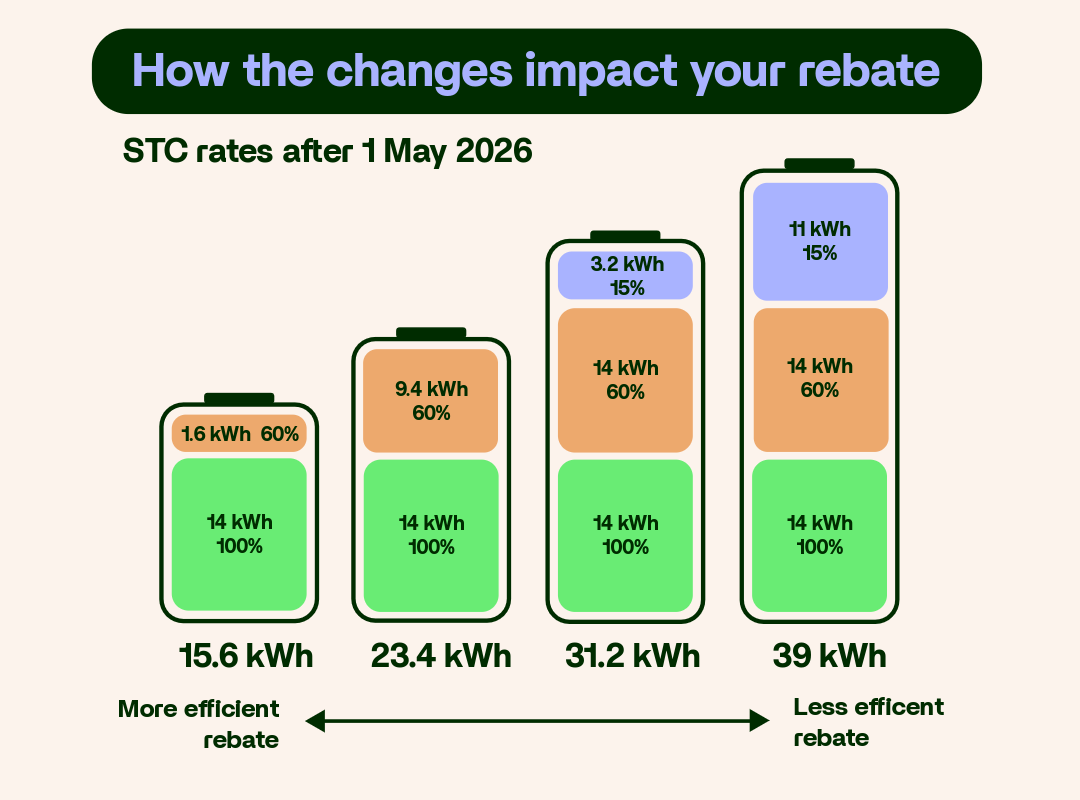
One more important detail: your rebate is locked in based on your installation date — specifically, the date your system passes its electrical compliance check — not the date you sign your contract or place your order. That single detail explains almost everything about why pricing changes when it does, so keep it in mind as you read on.
This is the bit that trips people up. If the rebate doesn't change until 1 January, why do solar and battery companies (Zelora included) start shifting pricing and promotions back in October?
The answer comes down to that installation-date rule above, combined with a very predictable seasonal squeeze:
Put those three things together, and you get a hard deadline that arrives well before 1 January.
That's why you'll typically see pricing and rebate-related offers shift in October, not December. It's not a sales tactic - it's the only way to make sure that everyone who books in still gets their system installed, certified, and locked into the higher rebate before installers down tools for the holidays.
If a battery has been on your radar, the practical takeaway is simple: the earlier you lock in your install, the more certain you can be of capturing the current, higher rebate. Waiting until December is genuinely risky — not because of price increases on our end, but because installer availability (not willingness) becomes the limiting factor.
A few sensible next steps:
The Cheaper Home Batteries Program rebate steps down again on 1 January 2027, continuing a schedule that will keep tapering every six months out to 2030. Because your rebate rate is locked in on your installation date — not your booking date — retailers start adjusting pricing and campaigns well ahead of the change, typically in October, to make sure installs booked in still get finished before installers close for the holidays.
If you've been meaning to get a quote, now's a genuinely good time to do it — not because of pressure tactics, but because of a calendar that's about to get very tight.
This means that installing your home battery by 30 April will get you a higher rebate discount per kWh, versus waiting until later in the year. It also means that now is a great time to get your quote sorted, so you've got the best chance of securing your install before the proposed rebate reduction on May 1, 2026.
Remember: your rebate discount is locked in on the day your battery is installed, so timing matters.